Showing posts with label Labyrinth Lord. Show all posts

Monday, April 30, 2012

Consider the rule-book, how it blossoms in its time


Be not ashamed of mistakes, and thus make them crimes - Confucius

So, long time, no post about Kitsune & Kensei, the updating/revision of 1E Oriental Adventures for Labyrinth Lord and its Advanced Edition Companion. I posted a brief thought about it all on G+, to whit that I was tempted to just run OA "as is" either in PbP or real-life. Just to see how it would run. That got me thinking about some aspects that I hadn't really considered before.

e.g. We all know about 1gp = 1xp and about how this becomes the primary motivator for the adventurer aka thieving scumbags, and how monsters become the roadblocks to be avoided or circumvented to achieve this. Where does this leave the humble shukenja and indeed most of the character classes, who (if played true to the mileu) would disdain to loot tombs and rob the dead?

(Mike D in Ruins & Ronin brilliantly avoids this problem by stating outright that his game emulates the historical/fantastic cinema of Japan, and thus the characters are every bit as ahistorical as their western paladin, magic-user equivalents.)

Also, with the whole new monetary system of OA, do we still keep the 1gp = 1xp standard, converting across each time, or do we need to rejig it to reflect the different distribution of money? That is, if we accept that the PCs are looters or that the DM will reward them with treasure/goods from their lord/monastery. It's the sort of thing that I should do a close analysis of, much as Chris K has done with the AD&D Name Level warbands and wandering "monsters" of berserkers, bandits etc.

My time is rather curtailed with a baby and performing with the local amateur dramatic society (and DMing 4E again), but I hope to have a bit more to say about this soon.

Saturday, April 28, 2012

People of the Pines - a coniferous creature for Labyrinth Lord


The People of the Pines lurk in dark woodlands, a curious perversion of the animal and plant kingdoms. Their origin remains mysterious at this time; perhaps they are the product of some twisted druidic cult, or a demonic infestation, or something wholly unknown to this particular facet of the multiverse...


These mysterious beings partake both of undead and plant natures, being the remains of humans (generally warriors) whose bodies have been drained of blood, with pine resin filling their veins in its place. The soul of such an unfortunate has departed but the individual's anima remains, investing the foul creature with the memories of its former self. Its new personality is curiously cold and distant, but encouraging of others to join them in the unfeeling serenity of their new state.


Labyrinth Lord stats 


No Enc: 1d10 (10d10)

Alignment: Chaotic
Movement: 120' (40')
AC: 5
HD: 3 
Attacks: 1 (weapon)
Damage: Sword 1d8 or Crossbow 1d6
SQ: Immune to non-magic weapons and cold, half damage from lightning, double damage from fire. Affected by plant-based spells.
Save: Fighter 3


For every 20 People encountered one will be a leader of 4HD, who will also have the powers and spellcasting ability of a 4th Level Druid. For every 60 encountered one will be a leader of 6HD with commensurate Druid abilities. People of the Pines are turned as shadows.


In battle, these creatures can emit a piercing scream which will cause enemy hirelings, retainers etc to check morale or flee for 1d8 rounds.


Adapted from Julian Lawrence's Brotherhood of the Pines in The Best of White Dwarf Scenarios III, themselves derived from Michael Moorcock's Corum series.

Saturday, April 14, 2012

Zoat - Guardians of the Woods


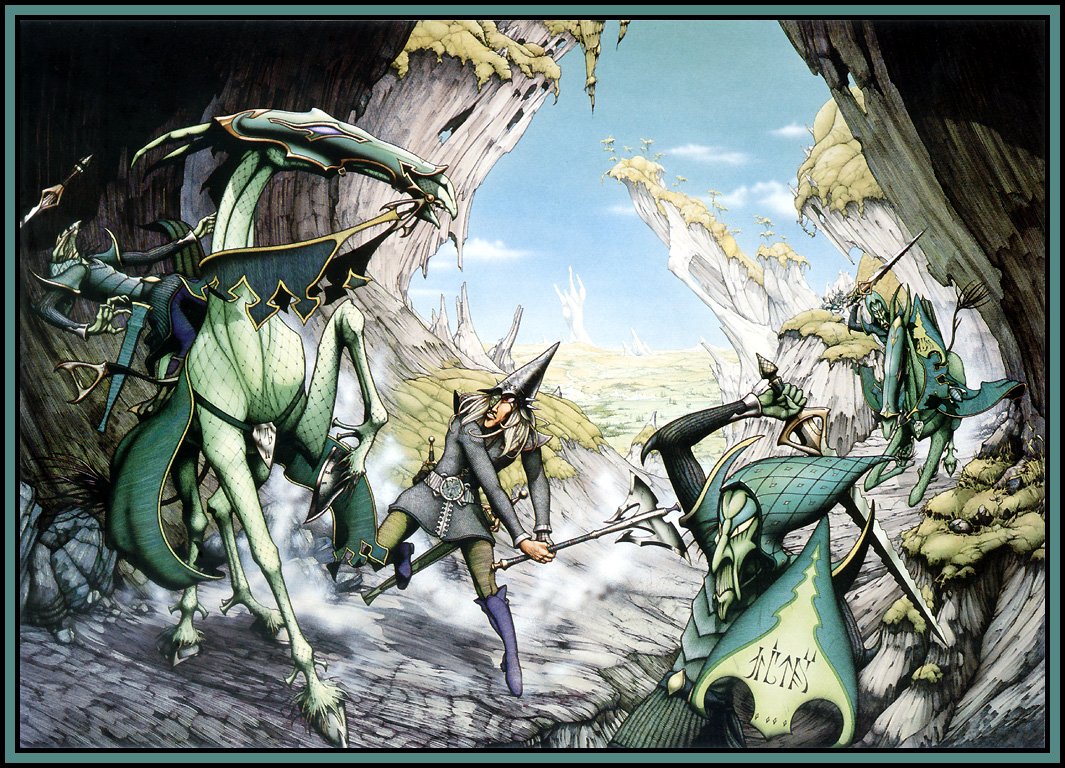
Image from Here Lives Goblins
The elves speak of a race that was old when they themselves were but new arrivals to the forests of creation. These wise reptilians resembled centauroid lizards, but had a charisma that far outweighed their deceptively lumbering form. Known as zoats or so-uts, the ancient ones may also have been the founders of the druidical faith, as they held a reverance and respect for the natural world and displayed great supernatural affinity with it.

It is said that some of the zoat race still linger in the primeval forests, slow to wrath but fearsome in battle.


Labyrinth Lord stats

No. Enc.: 1 (1d4)
Alignment: Neutral
Movement: 120' (40')
Armor Class: 3
Hit Dice: 7
Attacks: 1 (weapon or trample)
Damage: by weapon or 2d8)
Save: Druid 7
Morale: 12
Hoard Class: VIII
XP: 1,400

Zoats cast spells as a Druid of 7th Level. Ones with greater spell-casting ability undoubtedly exist. A zoat's great size (bigger than a rhino) allows it to wield two-handed weapons in one hand. Zoats deal double damage after a charge.


Monday, April 09, 2012

Alabast - Unwilling Exiles

They were like men but with hair and skin of purest white, and their eyes were pale,shimmering orbs of hate. Their leader addressed us, his tone one of curt disgust, "You are not wanted here, beasts. Leave or die"


The alabast appear to be kin to the elves and eladrin of other worlds but these mysterious beings take the isolationist tendancies of the fey to an extreme. On their shadowy homeworld, they dwelt in great ziggurat cities, the only sentient species on the planet; now, one of those cities lies on a strange and hostile world filled with bizarre, unwholesome species like and unlike the alabast.

It is unknown even if "alabast" is their name for themselves or one coined by the natives of their new world (i.e. the PC races). The alabast view all other sentient life-forms with at least distaste, and in some cases, hatred. Like the more familiar elves, alabast have a strong cultural tradition of blending swordplay and spellcasting, but this reaches its pinnacle in the warrior-mage caste of each alabast city state.


Labyrinth Lord stats

No Enc: 1d4+1 (1d10+10)
Alignment: Neutral
Movement: 120' (40')
AC: 5
HD 1
Attacks: 1 (weapon)
Damage: Sword 1d8 or Crossbow 1d6
SQ: Alabast are only surprised on a roll of 1 on 1d6
Save: Elf

These stats are for a typical NPC alabast warrior. For every 10 alabast encountered, one will be of higher HD of the iladan, teladan or koradan castes. Iladan ("Mage-warriors) are able to reflect magic back on the caster using their sword blades by making an attack roll as if attacking the caster in melee. Teladan ("Dancing-warriors") are able to make a riposte attack if their opponent misses them in melee. Koradan ("Shell-warriors") are more heavily armed and armoured than the other alabast one will encounter, usually wielding sword and shield or a two-handed weapon and wearing plate armour (but with no reduction in speed).

Alabast originally appeared in The Diamond Throne (Malhavoc Publishing)and the cultural terms used are from that work. My only original contribution is the LL stats and the abilities for the various types encountered.


Saturday, January 14, 2012

[Labyrinth Lord] Orgulus the Persuasive

It is a truth universally acknowledged that Labyrinth Lord rocks. You know the procedure: 3d6 in order (although I hadn't noticed that both LL and AEC say that the GM can ask you to roll the scores in any order you like). So, going to Invisible Castle yielded a series of 8s and 9s - that's not very interesting for the purposes of this, so I rolled again and got a much more characterful set of stats. Low Wisdom (again) - are the dice lords telling me something? Highest score Charisma? Oo, let's make him a real sleazebag, but upper crust with it... Not bad Int - let's go Magic-User!

Spells? Again, I hadn't seen before that in LL, M-Us choose 2 1st Level spells, and 1 2nd Level spell for their books. It's always weird to find little snippets like these. Allure is right up this cat's alley - an additional 2d4 Charisma? Whizzo! Sleep - it has to be. Invisibility - er, cos, really.

Money... er... can't find it in LL, as to how much I start off with, but it's in AEC weirdly. 3d8x10gp... 90gp - hmph. Not brilliant, but then again, what do M-Us need to buy? OK, let's see. He's gotta dress fancy, as an ex-girlfriend of mine would say. I'll keep some dosh to bribe people with and hire test subjects, er... retainers.

Orgulus (left) and an unfortunate hireling

Orgulus the Persuasive
Human Magic-User (Level 1)

Str 10 0
Dex 13 -1 AC, +1 Missile Attack
Con 14 +1HP/HD
Int 13 +1 language
Wis 07 -1 saves vs magic
Cha 15 -1 reac adj, 5 retainers, retainer moral 8

HD: 1d4+1
HP: 2

1st Level spells

Allure
Sleep

2nd Level spells

Invisibility

Equipment

65gp 3sp

Dagger
Quarterstaff
Spellbook
Silk robe
Fur cloak
Hat
Backpack
Scroll case
Quill pen
Ink vial

Thursday, November 17, 2011

Ninja - Kitsune & Kensei

Here she is, that most maligned of Asian archetypes/stereotypes, the ninja. She mixes bits of thief and assassin with acrobat, and was incredibly powerful, by Zeb's own admission, in the original OA. I've cut some abilities, as I still want thieves and assassins to be viable 'ninja'. The ninja character class represents one who has taken a mystical approach to the art of stealth.

At the moment I only have notes, so I will present these rather than a full write-up like the other classes (especially as I am working on compiling them).

Ninja

Reqs: 14 Dex, 15 Int, 14 Cha

1d4 hp
No Prime Requisite
Use any armour and weapon. Penalties to thief skills for wearing metal armour.
Combat and saves as Thief
Thief Skills
Move Silently


Hide in Shadows
Climb Walls
Backstab
Assassin Skills
Disguise
Assassinate
Unique Skills
Escape
Fall
Pole Vault
Tightrope 
Level based abilities
1st Level - Hold Breath
5th Level - Walk on Water
12th Level - Walk through Walls


Monday, October 31, 2011

Sohei Spell Progression

With apologies for the delay... a most exciting table.


Sohei Spells by Level


Sohei Spell Level
Level           1                 23                 4
1-6 - - - -
7 1 - - -
8 1 1 - -
9 2 1 - -
10 2 2 - -
11 2 2 1   -
12 3 2 1 -
13 3 2 2 -
14 3 3 2 -
15 3 3 3 -
16 3 3 3 1
17 3 3 3 2
18 4 3 3 2
19 4 4 3 3
20 4 4 4 3

Sunday, October 30, 2011

Kensei - Labyrinth Lord


The kensei had a bonkers original write-up, including a completely unique method of calculating the kensei's AC. I've eliminated abilities that have no easy applicability to Labyrinth Lord.


Kensei

Requirements: Str 12, Dex 14, Wis 12
Prime Requisite: Wis, Dex
Hit Dice: 1d8

The kensei is a master with one particular weapon (usually a sword, from the translation “sword saint”). Such a warrior has made it his or her objective to attain oneness of thought and action as well as attain moral purity.

Kensei cannot wear any kind of armor nor can they use shields. They are able to use any weapon, and must choose one weapon e.g. longsword to be their chosen weapon. The kensei gains certain bonuses (see below) when using his or her chosen weapon. Kensei use the Paladin Experience Table, Saving Throw Table and attack values. Kensei must be of Lawful alignment. Should a Kensei become Neutral or Chaotic, he or she ceases to advance in this class and advances henceforth as a Fighter (in this case the Kensei powers gained will not be accessible when wearing armor).

The Kensei receives a bonus of -2 to AC (in addition to Dexterity modifiers). His or her AC continues to improve by -1 at every 3rd Level (hence -1 at 3rd Level. -2 at 6th Level etc.) with a limit of -5 at 15th Level.

Kensei are immune to fear and receive a +1 bonus to all saving throws.

Once per day per level, the Kensei can focus his or her ki to cause maximum damage on a successful hit with his or her chosen weapon. The intention to use this ability must be announced before the to hit roll is made.

The intense dedication required of the Kensei's path places certain restrictions upon them:

  • Kensei avoid using magical weapons, as they wish to master their art without such aids. If a Kensei uses a magical weapon, the weapon's power eliminates any bonuses to hit or damage gained from the class (thus a 5th Level Kensei using a longsword +1 would add +1 to his or her attack and damage rolls, not +2).
  • Kensei cannot benefit from items that alter the character's natural AC (such as magical bracers). If a Kensei wears such an item, it has no effect on his or her AC.
  • The Kensei must practice for at least 2 hours per day. If a training session is missed, the Kensei must make up for any missed sessions before advancing to the next experience level. Thus, if a Kensei misses 1 day of practice, he or she must add a further 2 hours to a practice session before advancing. A Kensei can only practice for a maximum of 4 hours a day.

Reaching 2nd Level – The Kensei gains a +1 bonus to damage rolls with the chosen weapon. This increases by an additional +1 at 5th, 8th, 10th, and 12th Levels to a maximum of +5.

Reaching 3rd Level The Kensei gains a +1 bonus to attack rolls with the chosen weapon. This increases by an additional +1 at 5th, 8th, 10th, and 12th Levels to a maximum of +5. Note that this ability allows the Kensei to hit monsters that can only be hit by weapons of the specific plus needed (e.g. a gargoyle can be hit by a 3rd Level Kensei).

Reaching 4th Level – The Kensei can now meditate (as per the Shugenja ability).

Reaching 6th Level – The Kensei is now only surprised on a roll of 1. His or her allies are surprised as per normal (barring any special abilities).

Reaching 7th Level – The Kensei can cause fear (as per the Samurai ability)

Reaching 9th Level – 1d6 pupils (all 1st Level Kensei) are attracted by the Kensei's growing reputation. The pupils serve and study with their new master, and all have the same chosen weapon as him or her. There is a 5% chance per Level that the pupils gain that each will leave to pursue his or her own studies. Should the Kensei character be defeated in a duel, then there is a 50% chance per pupil that each will leave his or her service.

Reaching11th Level – The most famous and deadly ability of the Kensei is the Whirlwind Attack. This is another use of the Kensei's ki, and the character cannot have used any other ki powers that day. Using this power also prevents any further uses of ki powers for the next 24 hours. The Whirlwind Attack can only be made with the Kensei's chosen weapon. Using this power allows the Kensei to attack all opponents within 10 feet of him or her. This happens regardless of the number of attacks the Kensei could normally make. These attacks must all be made at the same time (i.e. the character cannot make some attacks, allow another PC to take a turn and then make further attacks).

Thursday, October 27, 2011

Sohei - Labyrinth Lord


I haven't done much with the Sohei, bar a smidgen of historical background (social class), and allowing them to use any weapon (my sohei in Ruins and Ronin was deadly with her shuriken). I've lessened the potential number of sohei troops as it would be a logistical nightmare to deal with 100 sohei all going ape. As usual, I've just tightened the writing in places. Have fun! Oh and I need to add their spell progression... Tomorrow. Honest.

Sohei

Requirements: Str 13, Con 10, Wis 10
Prime Requisite: Str, Wis
Hit Dice: 1d6

Sohei are warrior monks, defenders of temples and monasteries, trained more in the ways of war but with basic religious instruction. Sohei are often members of the warrior class who have some form of physical handicap or have suffered an accident (such as being thrown from a horse) that has left them less able than before. The temple gives them training and a renewed social status.

Sohei can wear any kind of armor but cannot use shields. They are able to use any weapon, but the polearm (naginata) is their traditional weapon. Sohei use the Cleric Experience Table, the Cleric Saving Throw Table and Cleric attack values. Sohei cannot be of Chaotic alignment.

Reaching 3rd Level – The Sohei learns to focus his or her ki to attain a state of berserk energy in combat. This frenzy lasts for 10 rounds, and can be activated once per day. While in this state, the sohei gains 1 extra attack per round, his or her AC improves by 1, his or her movement increases by, and he or she gains +1 to hit, damage rolls, and saving throws. Furthermore he or she is able to dodge missiles with a successful save vs breath attack.

Reaching 5th Level The Sohei can fight beyond 0hp, gaining +2 to hit and damage, until he reaches -10hp or the enemy is killed (whichever comes first). Once either of these conditions is fulfilled the sohei falls down dead. This is one of the greatest acts a sohei can perform, and much (posthumous) honour is given to one who dies in this manner.

Reaching 6th Level – The Sohei is given command of 1d3x10 1st level sohei. More 1st level sohei are available from his or her parent monastery to replace those who perish. At each level after 6th, the command is increased by a further 1d10 1st level sohei. None of these sohei gain levels.

Reaching 9th Level – The parent monastery of the Sohei gives him or her commission to found a new daughter temple. This includes escorting shugenja and monks to the site, clearing the land, building the temple, and overseeing defenses. The Sohei character becomes the commander of the new monastery's sohei, and can try to recruit more in addition to those he normally gains at each level. The Sohei and his forces are still answerable to the parent monastery.

Like shugenja, sohei must abide by certain religious restrictions, although the sohei's are less strict. The sohei must refrain from:

  • Eating meat (fish is allowed)
  • Excesses of behaviour (drunkenness, gluttony etc)
  • Murder

Tuesday, October 25, 2011

Nerd-Rage of the Rakasta

Just to get it out of the way, I'm talking about these guys:

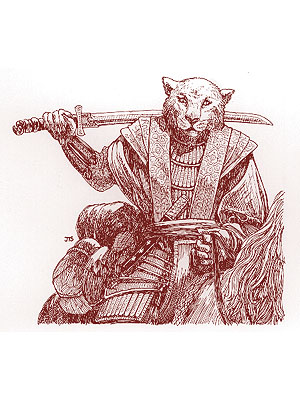
Mystaran cat-dude chillin'

NOT these guys:

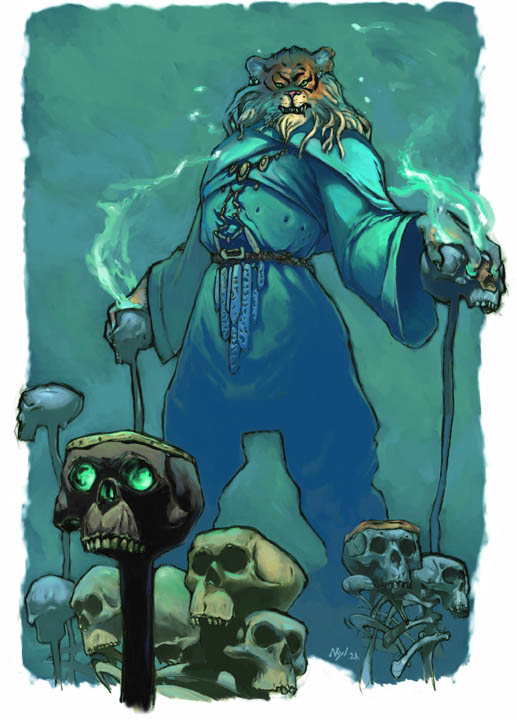
Evil tiger-spirit in the Temple of Doom


The rakasta first appeared riding their sabre tooth cats in X1 The Isle of Dread, and have become one of those breakout hits of D&D (albeit in a niche manner). They went on to get their own moon kingdom (Japanese inspired) orbiting the world of Mystara (the Known World and Hollow World of BECMI), as well as a kingdom on the Savage Coast (a Merrie Olde England parody). They have gone from B/X to BECMI to AD&D 2E and still have many fans online. Why am I going on about them?

Polyhedron 101. Roger E. Moore wrote a short article brainstorming an OA campaign set on the rakasta moon of Myoshima. It was a really fun thought experiment and although some people despise anthropomorphic animal characters, I think they can be interesting if done well.

Can I get the rakasta (or some very similar being with a name change) into my work on "OA for LL"? Just maybe.


Monday, October 24, 2011

I knew it must exist somewhere

Now I find this? Sounds good too.

Classes of the Far East

Is there a need for me to do this work? With this and Red Tide, I could be sorted. I guess I had better buy them. :D

EDIT: Just thinking out loud. I shall continue, as there are many classes that are not covered in either book.

"Oriental Adventures" for Labyrinth Lord

Just a status update to let interested parties know where I am with this project. I've scribbled down my notes for the sohei and kensei, and have had some more thoughts on things to alter or add to a potential Labyrinth Lord supplement, to whit:

Removing fox and racoon-dog from the hengeyokai and having them as either race-as-class under their correct designations of kitsune and tanuki, or shunting them to being monsters.

Finishing off the class conversions - except yakuza, as noted before. Maybe write up some outlines of how characters can fit into a yakuza or ninja clan.

Type up shugenja and sohei spell lists.

Convert spells not in AEC. My hope is that I can find them or equivalents in OSRIC or another clone.

Creating a setting outline... The urge to hexmap is strong in this one...

Putting weapons and armour notes into legible format.

House rule suggestions - rules "fixes" and genre emulation.

So, not much then!

What would be great is if any of you helpful readers had name suggestions for such a supplement. If so, please comment, thank you!

Tuesday, October 18, 2011

Towards an OA Retro-clone

The stars are right... all the omens are propitious...


Jagatai at Ramblings of a Great Khan is proposing an OA retro-clone for OSRIC, and Lord Gwydion  at What a Horrible Night to Have a Curse is putting the final touches on a clone of Chris Pramas' 2E-inspired game Dragon Fist. I've started doing ports of the OA classes and races to Labyrinth Lord. As can be seen the swell of Asian fantasy is building both in OSR and 'new-school' circles. To break it down with the current products and their parent games:

Ruins & Ronin (Swords and Wizardry) - Mike D (Sword +1) created the high-water mark of recent D&D oriental shenanigans with this excellent work. If you can't tell, I love this book. The inexhaustible imagination of Matt at THE LAND OF NOD has created Mu-Pan, a sandbox setting encompassing folklore, myth, pop fiction and game lore for Ruins & Ronin. Both have produced amazing, inspiring work.

Red Tide (Labyrinth Lord) - Another Asian sandbox with elements of horror and culture clash built in. I don't have this book, but everything I hear about it screams "buy me!" and its by Kevin Crawford, author of Stars Without Number. Nuff said. It introduces new races and classes

Jade Regent Adventure Path (Pathfinder) -  I have mixed feelings about Paizo as a company and of their products, but I applaud their re-introduction of Asian tropes into 3.x gaming. Wayne Reynolds art - another thumbs up.

Heroes of the Jade Oath (Arcana Evolved) - This has been in development for several years, and I don't know much about how transferable its ideas are, but there are free previews of it to download at RPGNow, and DriveThruRPG.

So, there's lots out there right now that caters to the desire to break out of Western Europe and get down with the samurai and the wu jen (these are all quite Chinese and Japanese inspired, but I pass no judgement on that).

Regarding what there is for OSRIC, a key work if someone were to embark on OA for OSRIC would be this OSRIC Unearthed. It has conversions for martial arts, the ninja, the yamabushi (new take on the monk), and the barbarian. I think that it should be the first port of call for someone looking to write/play/run OSRIC OA.

What would I want in an OA retro-clone? That's for another post!


Tuesday, October 11, 2011

Samurai - Labyrinth Lord

Now we all know that "samurai" was a social class, but for the purposes of this class write-up, the samurai character class stands above the other members of the nobility. Like the paladin, he is an ideal that few can attain. He is the samurai of legend and fiction, rather than history.


Samurai

Requirements: Str 13, Con 13, Int 14, Wis 13
Prime Requisite: Str
Hit Dice: 1d8

Samurai are elite warriors, well trained in many areas of warfare. In most cases, they serve a powerful lord, but some become ronin (“wave men”), free from feudal obligation, but without recourse to the wealth and influence of a patron. However, it is often these wandering samurai who make the greatest mark on the page of history. Not every member of the warrior class has the Samurai character class – these men and women are truly paragons of the warrior code.

Samurai can wear any kind of armor but cannot use shields. They are able to use any weapon, but are expected to carry a bastard sword (katana), both as a symbol of their status, and as a means of defence. Samurai use the Paladin Experience Table, and the Fighter, Paladin and Ranger Saving Throw Table. They attack using the Fighter values. Samurai must be Lawful in alignment.

Bushido, the way of the warrior, is a code that many of the warrior class try to follow, but the Samurai is its exemplar. This way can be summarized in seven essential principles:

  1. Gi: the right decision, taken with equanimity, the right attitude, the truth. Rectitude. The samurai educates his mind in order to better take the right course, even if that course is death.
  2. Yu: bravery tinged with heroism. The samurai must recognise fear, and conquer it.
  3. Jin: universal love, benevolence toward mankind; compassion. The samurai must recognise the suffering in others and aid them.
  4. Rei: right action--a most essential quality, etiquette, courtesy. The samurai must show respect and gratitude.
  5. Makoto: utter sincerity; truthfulness. The samurai must strive to be honest.
  6. Meiyo: honor and glory. The samurai must do that which reflects well on himself, without arrogance.
  7. Chugo: devotion, loyalty. The samurai is loyal to his lord, his family, his country, and to himself.

Kiai – by focusing the internal energies of the body (ki) into a fierce shout, the Samurai can increase his or her Strength to 18 (if it is already 18, then it increases to 19) for 1 round. A Samurai can focus his or her ki a number of times per day equal to his or her level.

Reaching 2nd Level – the Samurai gains +1 bonus to damage dice, this increases by +1 every 3 levels after 2nd

Reaching 3rd Level – Samurai can only be surprised on a roll of 1.

Reaching 5th Level The Samurai gains immunity to all types of fear.

Reaching 6th Level – The Samurai can choose to cause fear in all creatures with 1 HD or less (saving throw vs breath weapon). The Samurai can control whether this power is in effect at will. Any creatures who fail their save are struck with fear, either surrendering or fleeing from the Samurai. Any creature that passes the saving throw is immune to the fear effect for that encounter.

Reaching 7th Level – The Samurai is offered jito (stewardship) over one of the properties of his lord; the Samurai is under no obligation to accept. Should the Samurai refuse, then he or she is offered a fitting home in the city or camp where the lord makes his headquarters. If he or she accepts, then a shugo (constable of the province) watches over and directs the Samurai. As jito, the Samurai must watch over the area, settling disputes, protecting the property, collecting taxes and quelling rebellion. In return, the Samurai receives one quarter of the taxes collected.

The lord provides the new jitowith 10 fighters and 1d4 samurai (all of 1st to 3rd level). The loyalty of these men ultimately lies with their lord, but will serve the Samurai unless the lord intervenes. The Samurai will always retain his or her position as jito even as he or she increases in level. The duties can be assigned to an underling (in exchange for a portion of tax), and the Samurai is not required to remain on the property.

The Samurai does not own the property, but the only way it can lost is if the property is horribly mismanaged or the taxes are not turned over to the Samurai's lord. It is the lord's responsibility to seize control back from the Samurai in the event of revolt on the latter's behalf.

Reaching 8th Level – The lord offers the Samurai the position of shugo: if the Samurai accepts, he or she becomes responsible for the protection of a province and of protecting the lord's interests in that province. It is expected that the Samurai will administer justice and supervise the jito under him or her. The Samurai attracts 10d10 1st Level Fighters as followers, but there is a 20% chance that one of these is actually a spy sent to infiltrate the new shugo's household (the spy may be of another class such as a Thief or Ninja). No more than 1 spy will operate in the household. The fighters will be loyal to the Samurai as long as their needs are met (food, housing, adequate pay), and as long as the Samurai's fortune does not take a turn for the worse.

Reaching 9th Level – The Samurai attracts 2d10 1st Level samurai, all of whom are absolutely loyal to the PC. In addition, 1d6+1 specialists will request to be taken into the Samurai's service. There is a 10% chance that one of these is a spy (typically a Thief or Ninja) sent as a precaution.

Reaching 10th Level – The Samurai gains the power of the great kiai, or paralysing shout. The character's ki is summoned up in the form of a ferocious war-cry: all enemies within 10 feet must save vs paralyzation or be stunned for 1 round. (see p144 AEC). The Samurai's Strength is also increased to 18 for 2 rounds (if the Samurai already possesses a Strength of 18, then it increases to 19). The great kiai can only be used once per day, and the Samurai cannot use his normal kiai and the great kiai on the same day.

(Phew! That was a bit of work! On the menu still - ninja, sohei, shukenja and sohei spell lists, conversions of spells, monsters is... a whole bundle of trouble. I am not going to convert yakuza - thieves can cover that. I'm also not converting barbarians at the moment, until I can think of what to do with them.)

Saturday, October 08, 2011

Samurai Shenanigans

I'm quite pleased with how things are going with the conversions, but I'm now looking at the Samurai and sighing at the wonderfully involved but very campaign specific property and followers they gain. "At 7th level the samurai is offered jito (stewardship) over one of the properties of his daimyo" - that's awesome, but kind of a bind, when the rest of the party will be still wilderness exploring before hitting Name level (usually 9th). I'm really very tempted to condense it down, and offer the samurai stuff at 9th level. Anyway, blah blah blah, here are the Samurai Pizza Cats!

Thursday, October 06, 2011

Shukenja (Labyrinth Lord)

The following is adapted mostly from 1E Oriental Adventures, but the special martial arts abilities are entirely the work of Matt at Land of Nod and I can take no credit for them.


Shukenja

Requirements: Con 9, Wis 12
Prime Requisite: Wis
Hit Dice: 1d4

Shukenja are humble priests who wander the land dispensing aid and advice to the common man. Shukenja uphold virtuous principles, and must be Lawful in alignment. They are able to meditate, 1 hour of which is as restful as 2 hours of sleep. They remain aware of their surroundings and take no surprise penalty for being asleep. They can react as if awake to any threats. A Shukenja can apply a +3 bonus to any saving throw a number of times per day equal to his or her level. This must be declared before the saving throw is rolled.

Shukenja are unable to use shields or wear any kind of armor. They are able to use the following weapons: axe (hand), boku-toh, chain, gunsen, jitte, kama, kiseru, sai, sling, sling staff, quarterstaff, spear, tetsubo, three-piece rod, tui-fa.

Shukenja are also trained in self-defense; a shukenja can choose one of the following special abilities: 


1) Unarmed attacks do 1d6 damage; 
2) Flurry of blows – you can make 1 attack against a secondary opponent every other round; 
3) Iron Hold - With a successful attack you wrap your opponent up using your arms and even legs; equivalent of a hold person spell until your opponent makes a successful saving throw (penalty equal to difference between your strength and their strength). If your attack fails, you suffer a 1 point penalty to Armor Class until your next turn; 
4) Parry Blows – You can trade an attack during a round for a +1 bonus to your AC or the AC of a creature or object no more than 3 feet away from you; 
5) Parry Death Blow – Once per combat you can make a saving throw to retain 1 hp when a successful blow would otherwise have killed you.

The training a shukenja undergoes at a temple or monastery allows him or her to perform religious rituals, such as marriages, funerary rites, holy day officiations, and purifications. This last function can be used to lift curses and ward off evil influences. A Shukenja has a base chance of 5% per level to remove any curse, and when warding off evil, can sanctify an area with a radius of 5 feet (75 square feet); at the end of the purification ritual, everyone within this area gains a +1 to hit and on saving throws when fighting evil spirits. The effect lasts as long as the Shukenja remains within the purified area. Multiple rituals have no cumulative effect.

Shukenja use the Cleric experience table. They use the combat progression and saving throws of Clerics. Shukenja have their own spell list.

The Shukenja must follow a code of conduct set forth by his or her religion:

  • Cannot initiate violence – defending oneself is allowed
  • Must avoid killing whenever possible
  • Cannot eat meat
  • Must avoid immoderate eating and drinking
  • Cannot own more than he or she can carry

Sunday, October 02, 2011

Hubris and Comprehension

Upon re-reading sections of 1E, I have discovered that pieces of character class design that I thought I was re-inventing have turned out to be explicitly stated (if somewhat buried away) in 1E OA. e.g. the names of wu jen spell schools (Cook gives wood and metal as alternative names for nature and earth respectively) and the shukenja's code (the prohibition against needless violence is tucked away there).

I'm going back to edit the wu jen and the hengeyokai, to correct an omission and eliminate some redundancy.

Friday, September 30, 2011

No Violence!

Just about to type up my notes for converting the Shukenja (the healing religious guy) from 1E OA to Labyrinth Lord, via 2E and 3E.

Currently, it's looking like: no armour, restricted weapons, restrictions on equipment carried, code of conduct, turn undead, lift curses, cast spells (mixture of cleric and druid).

The shukenja originally had a set of restrictions on how it could gain XP: you actually gained no XP for killing opponents, but gained a lot of XP for healing random people you met. There were others as well, but I think I won't fiddle with the XP, but instead build into the code that the shukenja shouldn't initiate violence, and try to avoid killing. This is D&D, after all.

Wednesday, September 28, 2011

Wu Jen Spell List (Labyrinth Lord)


I've put together the spell list for the wu jen. You can get it HERE . The schools are: Earth, Fire,  Metal, Water, and Wood. These are derived from 3E OA's division of spells; the original 1E OA divided them into Air, Earth, Fire, Nature, Water. I might go back and create an Air and Nature school as well at a later date. An asterisk denotes spells from 1E OA, and 3E denotes ones from 3E OA.

Sunday, September 25, 2011

Wu Jen (Labyrinth Lord)

(The following is a conversion of the wu jen from Dragon #229 originally for 2E, and the original wu jen from 1E Oriental Adventures, both by the fantastic David "Zeb" Cook)

Wu Jen

Requirements: Int 9, Con 12
Prime Requisite: Int
Hit Dice: 1d4+1 at 1st Level; 1d6 thereafter

Wu Jen are spellcasters from a very different tradition to the standard magic-user. Each studies a particular school of elemental spells under a lone master, often in a remote location. Wu Jen train their bodies and minds to be as one. They are able to meditate, 1 hour of which is as restful as 2 hours of sleep. They remain aware of their surroundings and take no surprise penalty for being asleep. They can react as if awake to any threats. Wu Jen have frequent dealings with spirit creatures, and can speak the languages of oni and tengu.

Wu Jen are unable to use shields or wear any kind of armor. They are able to use any weapon. They are people who study the changing forces of nature, and cannot be of Lawful alignment

Wu Jen use the Magic-User experience table. They use the combat progression, and saving throws of magic-users. Each Wu Jen must choose a school of spells; once chosen, it cannot be changed, and no spells can be chosen from other schools. Each time a wu jen gains a new experience level he can only learn 1 new spell (of any level he can cast), but they have no need to memorise their spells, nor do they use spellbooks. 


In order to cast a spell, the Wu Jen spends triple the spell's level in HP; thus, casting a magic missile costs 3 HP. A Wu Jen can never cast a spell requiring more HP than he currently has. Because of their reliance on their body's own power, wu jen only receive half the benefit (rounded up) of healing spells; e.g. if a cure light wounds spell would normally heal 4 HP, the wu jen is only healed for 2 HP).

Certain taboos must be abided by in order for the Wu Jen to sustain his magic. Examples include:

  • Cannot bathe
  • Must bathe frequently (at least every other day)
  • Cannot sit facing a certain direction
  • Cannot touch a dead body
  • Cannot wear shoes
  • Cannot drink alcohol

The DM and player should feel free to create their own taboos, as long as they are as restrictive as the examples above. Taboos should relate to purity or cleansing of the body. At 1st Level, the Wu Jen must choose 1 taboo, and then another at every fifth level. Failure to abide by taboos results in the loss of spell-casting ability for 2d4 days.

Reaching 6th Level: Wu Jen gain the ability to enhance any one of Strength, Dexterity or Constitution by 1d4 points for 2d4 rounds. The effort required costs the wu jen 1d6+2 hitpoints. Ability scores cannot be increased beyond racial maximums, and any adjustments are applied immediately. They are not retroactive (e.g. increasing Constitution does not increase hitpoints). This ability can be used multiple times, but only once per round.

Reaching 10h Level: The Wu Jen gains 1d4 pupils, all 1st Level Wu Jen. When each pupil gains a level, there is a cumulative 5% chance that he or she will leave to pursue their own study. Each that leaves is replaced by a new 1st Level pupil (unless the pupil leaving was mistreated).

Reaching 12th Level: By spending 1 HP, the Wu Jen can leap up to 30' in any direction. The Wu Jen can perform a series of leaps in a round, up to his normal movement rate.